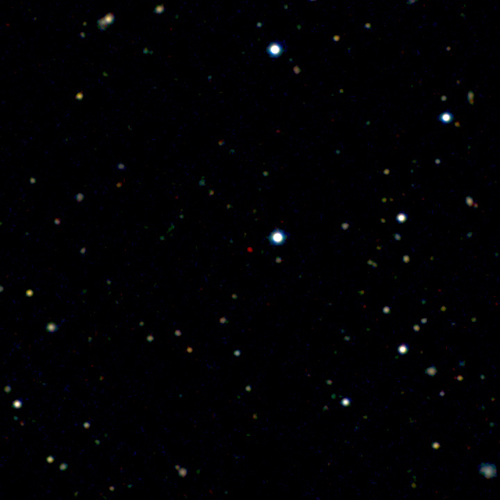
The most distant quasar has been discovered, marking a significant leap in our understanding of cosmic time. This remarkable finding opens new avenues for astronomical research and exploration.
What is a Quasar?
A quasar, or “quasi-stellar object,” is an extremely luminous and distant celestial entity powered by a supermassive black hole at its center. These fascinating objects emit enormous amounts of energy, often outshining entire galaxies. The light we observe from quasars has traveled billions of years to reach us, allowing astronomers to study the universe’s early stages.
Quasars are typically located at the centers of galaxies and are formed when surrounding material falls into the black hole, generating intense radiation across the electromagnetic spectrum. The most distant quasar discovered to date provides invaluable insights into cosmic evolution and the formation of the first galaxies.
Key characteristics of quasars include:
- Luminosity: They can be billions of times brighter than the sun.
- Distance: Many are located billions of light-years away.
- Redshift: Their light is significantly redshifted due to the expansion of the universe.
Significance of the Discovery
The discovery of the most distant quasar is a significant landmark in astrophysics, providing critical insights into the early universe. This quasar, identified as J0313-1806, is located approximately 13.03 billion light-years away, which places it at a time when the universe was only about 670 million years old. Its existence challenges previous notions about the formation of supermassive black holes and the evolution of galaxies.
Scientists highlight several key implications of this discovery:
- Understanding Cosmic Evolution: It sheds light on how black holes grew in the early universe.
- Insights into Quasar Formation: The quasar’s unusual brightness offers clues about the conditions required for quasar formation.
- Testing Cosmological Models: This finding tests existing theories about the universe’s expansion and structure.
Overall, the most distant quasar serves as a crucial piece in the puzzle of cosmic history.
How Quasars are Detected
Detecting quasars, especially the most distant quasar, involves sophisticated techniques and advanced technology. Astronomers typically rely on a combination of methods to identify these luminous objects.
- Optical Surveys: Large telescopes conduct extensive surveys of the night sky, capturing images that reveal the presence of quasars. These images help researchers pinpoint potential candidates for further study.
- Spectroscopy: Once a quasar is identified, astronomers use spectroscopy to analyze its light spectrum. This analysis provides crucial information about the quasar’s distance, chemical composition, and the speed at which it is moving.
- Redshift Measurements: The redshift of a quasar indicates how much its light has stretched due to the expansion of the universe. Higher redshift values suggest that the quasar is more distant, allowing scientists to learn about the early universe.
These methods combined have led to the remarkable discovery of the most distant quasar.
Impact on Astronomy
The discovery of the most distant quasar has profound implications for the field of astronomy. It not only challenges existing theories about the early universe but also offers new insights into the formation of galaxies and black holes. The light from this quasar, which has traveled over 13 billion years to reach us, provides a unique glimpse into the conditions of the cosmos shortly after the Big Bang.
Researchers are excited about the potential to study:
- Cosmic evolution during the universe’s infancy
- The behavior of matter and energy in extreme environments
- The role of supermassive black holes in galaxy formation
As scientists analyze the data from this discovery, it is expected to reshape our understanding of cosmic history and the fundamental processes that govern the universe.
Future Research Directions
The discovery of the most distant quasar opens up exciting avenues for future research in astrophysics. Scientists are eager to explore various aspects related to this quasar, aiming to understand its formation and evolution in the early universe. Some key research directions include:
- Investigating the host galaxy: Understanding the characteristics of the galaxy surrounding the most distant quasar can provide insights into cosmic structures.
- Studying black hole growth: Researchers are interested in how supermassive black holes grew to such sizes within a short time after the Big Bang.
- Analyzing light spectra: The light emitted from the quasar can help scientists learn about the conditions of the early universe and the intergalactic medium.
These research efforts will not only deepen our knowledge of quasars but also contribute to our understanding of the universe’s evolution.
Public Interest in Space Exploration
The recent discovery of the most distant quasar has sparked immense public interest in space exploration. As scientists unveil the mysteries of the universe, more people are becoming fascinated by celestial phenomena. This particular quasar, dated to be over 13 billion years old, offers a glimpse into the early universe, igniting imaginations and curiosity across various demographics.
Public engagement through social media, documentaries, and educational programs has grown significantly, allowing enthusiasts to connect and discuss these groundbreaking findings. The excitement surrounding this discovery highlights the importance of accessible scientific communication.
Moreover, local astronomy clubs and planetariums are witnessing increased attendance as individuals seek to learn more about quasars and the universe. The quest for knowledge encourages a deeper appreciation for science, fostering a generation of future astronomers and researchers.
- Increased social media discussions
- More educational programs
- Growth in community astronomy events
By UKIRT/Liverpool Telescope via Openverse



One thought on “Most Distant Quasar: A Clear Discovery Worth Celebrating”